Your cart
There are no more items in your cart
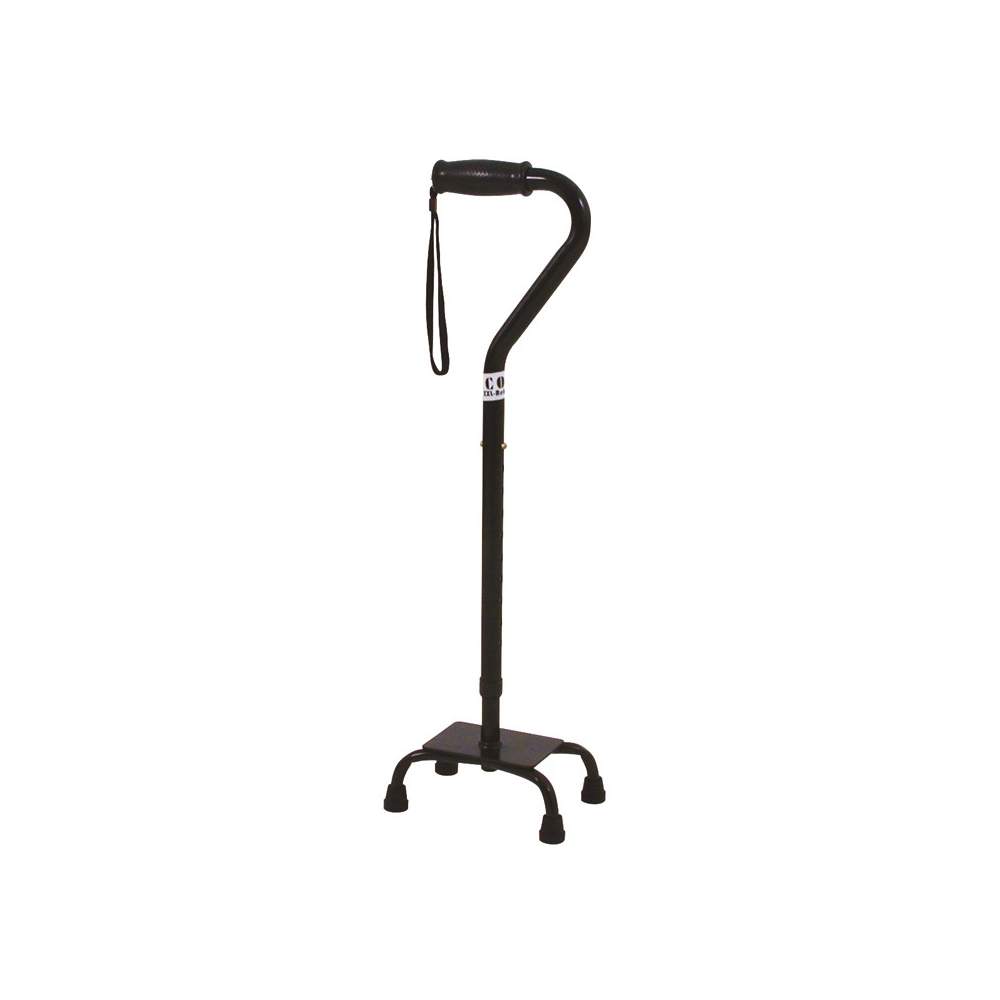
XL Quad Cane AD474XL

Vida diaria
€65.45
Tax included
*
Delivery: 1 to 2 weeks (Europe)
Four-legged walking stick AD474XL: adjustable from 71 to 93 cm, up to 270 kg. We remind you of two things almost nobody knows: it goes in the hand opposite the bad leg, and the grip is set at wrist height.
A four-legged stick stands up on its own and does not fall when you let go of it. That is its appeal and also its limit: it gives much more stability than a normal stick, but it forces you to walk more slowly, because all four feet have to land fully with each step.
It is the support for someone who no longer trusts a single-point stick, and the intermediate step before a walking frame.
Four legs and 270 kg: the reinforced quadripod
71 to 93 cm
Adjustable height
270 kg
Maximum user weight
1 kg
Weighs
The stick goes in the hand OPPOSITE the bad leg
It is the first thing taught in rehabilitation and the first thing almost everybody gets wrong: the stick does not go on the side that hurts.
If the bad leg is the right one, the stick goes in the left hand, and it moves forward at the same time as the bad leg. That way the support is spread diagonally, which is how the body walks naturally, and the painful leg is genuinely relieved.
- With the stick on the bad side the body leans towards that side, the already painful leg takes more weight and you walk worse.
- Order of the step: first the stick and the bad leg together, then the good leg. Going up steps, the good leg first; going down, the stick and the bad leg first.
If you have had surgery or a prosthesis fitted, follow your physiotherapist over this: there may be different instructions for your particular case.
The height: the same old rule, the wrist one
A short stick makes you hunch and a long one lifts the shoulder. Both tire you out and both take away balance instead of giving it. The right measurement takes ten seconds:
- Standing, in the shoes you normally wear and the arm hanging relaxed at your side.
- Have someone measure from the floor to the wrist bone. That is the height of the stick's grip.
- At that height, when you lean on it the elbow is slightly bent, about fifteen or twenty degrees. If the arm is completely straight, it is too long.
Check that the stick's adjustable range includes your measurement before buying it. Tell us the height and we will tell you whether it fits.
How it is used, which is not like a normal stick
The all four feet have to land at the same time with each step. If it lands on an edge, the stick tips and goes, which is exactly the opposite of what you want. That is why it forces you to go more slowly.
The feet always go on the outside, away from the body, so you do not trip over them. And on stairs it is not the right support: there the handrail is better.
Which one in the range
Look at the ferrule: it is the part that decides whether you slip
The rubber on the tip is the only thing that separates a walking stick from a plain stick. It wears out without you noticing, because the wear is gradual: one day it stops gripping on the wet floor of an entrance hall, and that is where the fright is.
Check it every few months and change it as soon as the tread is smooth or the edge is eaten away at an angle. It costs a few euros and it is the best safety investment in the whole of orthopaedics.
Changing it needs only one piece of information: the diameter of the tube, which is usually 17 or 19 mm.
Orthoprosthetic funding (Spain)
Code ask us · product included in the Spanish National Health System catalogue
Let us be clear, because a lot of websites get this wrong: we do not have this item's health service code recorded, and we are not going to make it up. What goes into the Spanish National Health System catalogue and under which code is decided by the rehabilitation doctor on the prescription.
And if you want to know what the benefit covers in general, we explain it here: How Spanish grants and funding work.
Full technical specification
Model: AD474XL
Adjustable height: from 71 to 93 cm
Weight: 1 kg
Maximum user weight: 270 kg
Frequently asked questions
Which hand is it held in?
In the one opposite the leg that hurts, and it moves forward at the same time as that leg. It is the first thing taught in rehabilitation and the first thing almost everybody gets wrong.
What height should I set it to?
Standing and in your own shoes, the grip has to come to the height of your wrist bone with the arm hanging relaxed. This one adjusts from 71 to 93 cm.
Is it better than a normal stick?
It is more stable, because it stands up on its own and spreads the support over four points. But it forces you to go more slowly and on stairs it is not the right support: there, a handrail. It is neither better nor worse, it is for a different moment.
And the rubber on the tip?
It is the part that decides whether you slip, and it wears out without warning. We have replacements: Flexyfoot, with a shock absorber and pivot and Maxi 70 mm ferrule. Tell us the diameter of the tube and we will send you the right one.
Is it covered by the Social Security benefit?
We do not have the code for this item on record and we do not invent it. Who is entitled and under what code is decided by the rehabilitation doctor on the prescription.
Ayudas Dinámicas, who is behind it
Who we work with to bring you this
Ayudas Dinámicas has spent 20 years developing and distributing assistive devices in Spain, with more than 8,000 m² of premises and more than 1,200 items in stock in continuous rotation.
For you that translates into two concrete things:
- There are spare parts and there is continuity. What wears out on a walking stick is the ferrule and the grip, not the tube: it is worth being able to replace them. And whoever sold it to you still has the part years later.
- They train their distributors. We went through that training, and that is why we can tell you no before selling you something that is no use to you.
New product
No reviews
Tap to zoom