Your cart
There are no more items in your cart
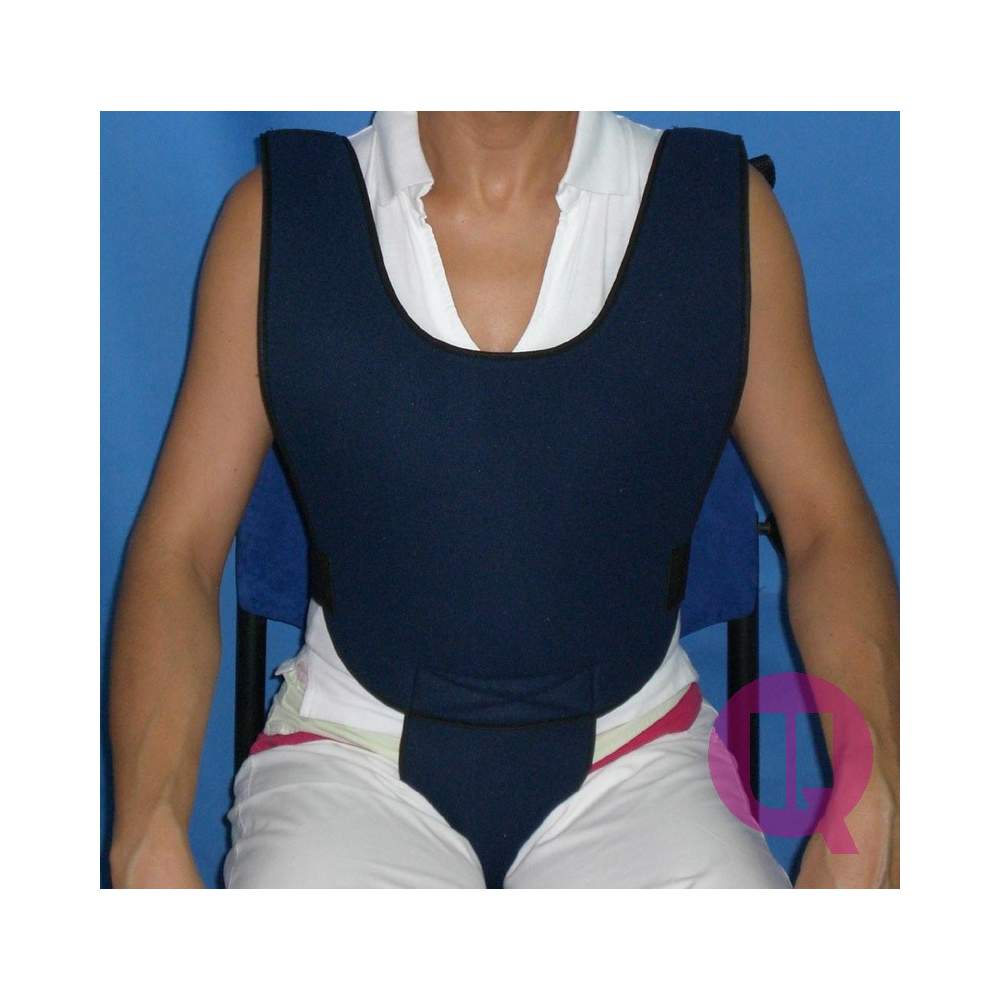
Padded Armchair Perineal Vest

305615
€38.99
Tax included
*
Delivery: 1 to 2 weeks (Europe)
ARMCHAIR PADDED size S
A restraint vest perineal to armchair, in padded.
What sets it apart from the abdominal one is the perineal band: it passes between the legs and stops the person slipping downwards. This matters more than it seems, because sliding down under an abdominal belt and ending up hanging from it is the most serious accident a restraint can cause.
This is the size S.
S
Size
padded
Fabric
buckles
Closure
perineal
Area
It holds without squeezing
It is the manufacturer's argument and it is what separates a properly made restraint from a makeshift one: it holds without squeezing, allowing postural changes and care by second persons. That is, the person can keep moving and the carer can get access without undoing everything.
What it really prevents
That the person leans over, slips or suffers injuries from bad postures. In someone who spends hours sitting without trunk control, slipping down is not a discomfort: it ends in pain, in deformity and in skin lesions.
Why perineal and not just abdominal
Because an abdominal band alone does not stop sliding downwards. If the person slips down, the belt rides up towards the chest and can end up compressing it: that is the situation to be avoided at all costs. The perineal band blocks it from below.
Buckle fastening
It is fastened at the back, with an adjustable fastening: it stays out of the person's reach and adjusts to each body. It is the economical option and the one most used; if the person manages to undo it, then what is needed is an IronClip safety fastening.
Padded fabric
It has foam between the outside and the inner face, so that the pressure is spread instead of concentrating on the edge of the strap. That is what you want when the restraint is going to be worn for many hours or the skin is delicate.
How it is placed
It is fastened at the back with an adjustable fastening.
This is a restraint, and it is best said that way
A restraint is not bought for the convenience of the person giving care. It is prescribed by whoever is in charge of the care —doctor, nursing staff or the team at the facility—, it is used for the shortest possible time, it is checked regularly and it is removed as soon as it is no longer needed. If you are unsure whether you need it, call us and we will talk it over before selling you anything: there is often a less restrictive solution that works just as well.
What has to be watched, and how often
That it does not press —a flat hand must fit between the band and the body—, that there are no folds underneath, that the skin at the edges is not left marked, and that the person does not become more agitated from wearing it. It has to be checked several times a day and released for spells. A mark that has not gone within half an hour means something has to change.
It can be made in any size
The manufacturer says so, and it is useful to know: if none of the catalogue sizes fits you —a special chair, a very large or a very small person—, it can be ordered made to measure. Tell us the case and we will ask.
Washing and checking the material
It is machine washed on a gentle programme. And it is worth checking the strap and the fastening from time to time: an open seam or a tired buckle turn a restraint into false security.
How to choose a chair or armchair restraint
Four decisions, in order of importance. Area: the abdominal belt is the most basic; the perineal belt stops slipping downwards; the vest spreads the support across the whole trunk; the abdominal belt with braces stops the band riding up. Support: the chair strap measures 160 cm and the armchair, 310. Fabric: padded for many hours or delicate skin, breathable for the heat. Closure: buckles, or IronClip if the person undoes it. And if what has to be positioned are the legs or the hands: abductor belt, ankle restraint and wrist straps. Everything in belts and vests.
Full technical specification
Type: Perineal vest ARMCHAIR PADDED
Indicated for: indicated as a basic means of restraining the patient in an armchair (geriatric chair)
Size: S
Closure: buckles, adjustable
Outer: Polyester 100%
Inside: Foam padding
Inner face: Suede-effect fabric
Strap: Polyester 100%
Closure: Tridente
Reference: 305615
Data from the manufacturer's product sheet.
Frequently asked questions
Does someone have to prescribe it for me?
Yes: a restraint is prescribed by whoever is in charge of the care, it is used for the minimum time and it is checked. If you have doubts, call us on 976 225 883 or 659 38 38 38 and we will talk it over before you buy anything.
How do I know it is not too tight?
A flat hand must fit between the band and the body. And the skin at the edges has to be looked at several times a day: a mark that has not gone within half an hour means something has to change.
Can the person undo it?
It is fastened at the back, out of reach. If even so they manage to open it, then the version with the IronClip safety fastening is what is needed.
Which size do I order?
There are S, M and L. It is chosen by the trunk circumference, not by clothing size. If you are between two, tell us the measurement and we will confirm it.
Can it be washed?
Yes, in the machine on a gentle programme. Check the seams and the fastening from time to time: a tired restraint is false security.
New product
No reviews
Tap to zoom